
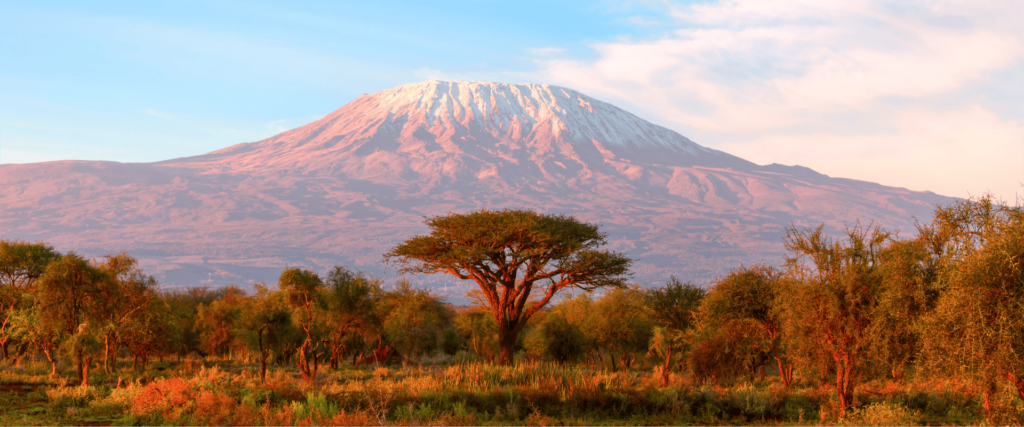
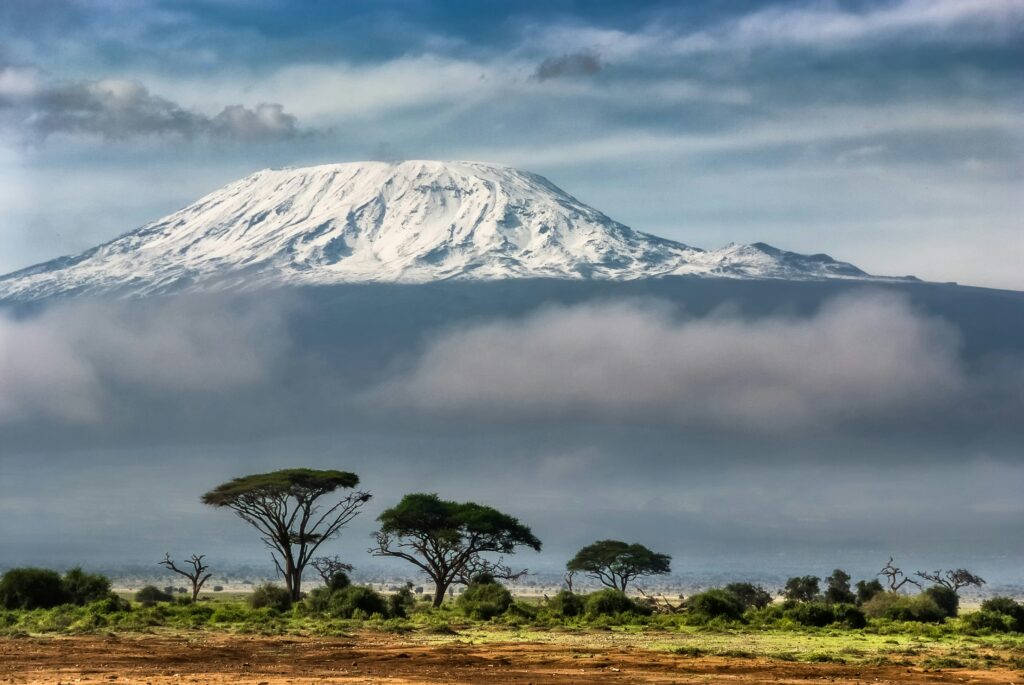
Mount Kilimanjaro is the highest mountain – dormant volcano – in Africa and the highest free-standing mountain in the world. This snow-capped peak is one of the most perfectly formed and certainly the most spectacular. Its fame has spread far and wide, attracting mountain climbers and nature lovers alike with its magnetism. The mountain can be climbed through several routes, e.g. Machame, Marangu, Lemosho, Londorosi, Rongai and Umbwe.
History
Mount Kilimanjaro is located in northern Tanzania, just 20 km from the border with Kenya and only 330 km south of the equator. It is part of Kilimanjaro National Park, which covers an area of 1688km2. It was established in 1973, officially opened in 1977 and declared a World Heritage site in 1987 by UNESCO.
Mount Kilimanjaro has three significant volcano peaks that are known:
- Kibo 5 895m (19 341 ft) – was the last one to erupt, 300 000 years ago
- Mawenzi 5 149m (16 893 ft) – was the second to erupt, 500 000 years ago
- Shira 3 962m (13 000 ft) – first one to erupt 800 000 years ago
Climate
Mount Kilimanjaro’s climate varies greatly due to its changing elevations. At the base, the tropical climate experiences two rainy seasons, from March to May and November to December, with lush forests and frequent rainfall. As you ascend, the climate becomes cooler and more temperate, with grasslands and forests between 1,800 and 3,000 meters. From 3,000 to 4,500 meters, the climate becomes alpine, with colder temperatures, rocky terrain, and little vegetation.
At the summit (5,895 meters), the climate is frigid year-round, with snow and ice. The climate is influenced by trade winds that bring moisture, creating a wet season (March to May) and a dry season (June to September). The best time to hike is from June to October and January to February, when the weather is drier and more favorable for trekking.